Choosing the right cable and internet plan can feel overwhelming, especially when you are staring at dozens of providers, speed tiers, and pricing options all competing for your attention. Whether you are a remote worker who needs rock-solid connectivity, a family streaming movies on multiple devices simultaneously, or a casual browser looking for the best deal, understanding how cable internet plans work is the first step toward making a smart decision. This guide breaks down everything you need to know about cable internet packages, from speed tiers and pricing structures to hidden fees and bundled services, so you can confidently pick the plan that fits your household.
What Is a Cable and Internet Plan?

A cable and internet plan refers to a service agreement between a consumer and a cable provider that delivers broadband internet access through coaxial or fiber-coaxial infrastructure. These plans typically range from basic entry-level speeds suitable for light browsing to ultra-fast gigabit tiers designed for heavy users and large households. Many providers also offer cable internet deals that bundle TV, phone, and internet services into a single monthly invoice, often at a discounted rate compared to purchasing each service separately.
The underlying technology for most cable internet plans relies on existing coaxial cable networks originally built for television distribution. Data signals travel through these cables using a technology called DOCSIS (Data Over Cable Service Interface Specification), with the latest DOCSIS 3.1 and 4.0 standards enabling significantly faster speeds and greater bandwidth capacity. Some providers have also begun deploying hybrid fiber-coaxial (HFC) networks, which bring fiber-optic connections closer to your home before transitioning to coaxial cable for the final stretch, improving reliability and speed consistency.
Types of Cable Internet Plans
Basic Cable Internet Plans
Basic plans typically offer download speeds between 50 Mbps and 200 Mbps. These internet cable packages are ideal for individuals or small households with one or two people who primarily use the internet for email, social media, standard-definition video streaming, and light browsing. Most basic plans fall in the $40 to $60 per month range, though introductory pricing often drops this lower for the first 12 months.
Mid-Tier Cable Internet Plans
Mid-tier plans usually deliver speeds from 200 Mbps to 500 Mbps. These are well-suited for families or small offices where multiple devices stream simultaneously, attend video conferences, and download large files. Pricing for mid-tier cable internet deals generally falls between $60 and $90 per month.
Gigabit and Ultra-Fast Cable Internet Plans
Gigabit plans offer download speeds of 1 Gbps (1000 Mbps) or higher, and in some cases up to 2 Gbps or 5 Gbps with DOCSIS 4.0 infrastructure. These plans cater to power users, content creators, smart home setups with dozens of connected devices, and households where everyone is online at once. Expect to pay $90 to $130 per month for gigabit cable broadband plans.
Key Factors to Consider When Choosing a Cable Internet Plan
- Speed Requirements — Assess how many devices will be connected simultaneously and what activities you perform online. Video conferencing and 4K streaming demand significantly more bandwidth than casual browsing.
- Data Caps — Many cable providers impose monthly data limits, typically ranging from 1 TB to 1.2 TB. Exceeding these caps can result in overage fees or throttled speeds.
- Contract Terms — Some providers lock you into 12- or 24-month contracts with early termination fees. Others offer no-contract options at a slightly higher monthly rate.
- Equipment Costs — Check whether the plan includes a modem and router or if you need to rent or purchase equipment separately. Monthly rental fees of $10 to $15 can add up significantly over time.
- Upload Speeds — Download speeds often get the most attention, but upload speeds matter for video calls, cloud backups, and content uploads. Symmetrical upload and download speeds are increasingly available on higher-tier plans.
- Reliability and Latency — Cable internet is generally reliable, but shared network infrastructure means speeds can fluctuate during peak usage hours in your neighborhood.
Cable Internet vs. Other Connection Types
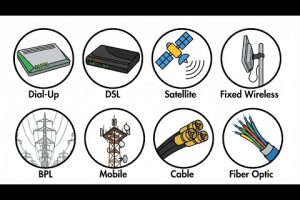
Understanding how cable internet compares to other broadband technologies helps you make an informed choice. Below is a comparison of the most common connection types available today.
| Feature | Cable Internet | Fiber Optic | DSL | Satellite |
| Typical Download Speed | 50 Mbps – 5 Gbps | 250 Mbps – 10 Gbps | 5 Mbps – 100 Mbps | 25 Mbps – 500 Mbps |
| Typical Upload Speed | 5 Mbps – 50 Mbps | 250 Mbps – 10 Gbps | 1 Mbps – 20 Mbps | 3 Mbps – 10 Mbps |
| Latency | 15–30 ms | 1–10 ms | 30–60 ms | 500–700 ms |
| Availability | Widely available | Limited to urban/suburban areas | Most rural areas | Nationwide |
| Price Range | $40 – $130/month | $50 – $150/month | $20 – $70/month | $50 – $150/month |
| Data Caps | Common (1 TB typical) | Rare or none | Sometimes | Often restrictive |
Fiber optic internet is the gold standard for speed and reliability, but it is not available everywhere. Cable internet strikes an excellent balance between performance and accessibility, making it the most popular broadband choice for millions of households. DSL remains a viable option in rural areas where cable and fiber are unavailable, though speeds are significantly lower. Satellite internet has improved dramatically with newer constellations, but latency and weather sensitivity remain notable drawbacks.
Bundled Cable and Internet Plans: Are They Worth It?
One of the most popular strategies for saving money is opting for a cable TV and internet bundle. Providers like Xfinity, Spectrum, Cox, and Mediacom frequently offer discounted rates when you combine two or more services. Bundling can save you $10 to $40 per month compared to purchasing each service independently.
Pros of Bundling
- Lower monthly cost through promotional pricing
- Single bill simplifies payment and account management
- Access to premium TV channels and on-demand content
- Unified customer support for all services
Cons of Bundling
- Promotional rates often expire after 12 months, leading to significant price increases
- You may pay for TV channels you never watch
- Early termination fees apply if you want to cancel one service but keep the other
- Contract lock-in periods can be lengthy
If you decide to bundle, carefully read the fine print. Look for plans that include price locks for at least 24 months, and calculate the total cost including equipment rental fees, taxes, and any activation charges before committing.
Hidden Fees to Watch Out For
Not all cable internet deals are as straightforward as they appear. Many providers tack on hidden fees that can inflate your monthly bill by $20 to $50 or more. Common hidden charges include:
- Equipment rental fees — Modem and router rentals typically cost $10 to $15 per month
- Broadcast TV fees — Even if you do not subscribe to cable TV, some providers charge a mandatory broadcast fee
- Regulatory fees — These government-mandated surcharges are passed on to consumers
- Early termination fees — Can range from $50 to $200 per remaining month on a contract
- Installation fees — Professional installation can cost $50 to $200, though self-installation kits are sometimes free
- Overage charges — Exceeding data caps may result in $10 to $100 in additional fees
Always ask for the total monthly cost before signing up, including all taxes, fees, and surcharges. This gives you an accurate picture of what you will actually pay each month.
Expert Tips for Getting the Best Cable and Internet Plan
- Negotiate your rate — Call customer service and ask for a retention offer or promotional rate. Providers frequently have unadvertised discounts available for existing or returning customers.
- Buy your own modem — Purchasing a DOCSIS 3.1 compatible modem for $80 to $150 can eliminate $120 to $180 in annual rental fees.
- Monitor your usage — Use your provider’s app or portal to track data consumption and avoid overage charges.
- Check for local alternatives — Municipal broadband networks, fixed wireless providers, and 5G home internet may offer competitive alternatives to traditional cable plans in your area.
- Reassess annually — The cable market changes frequently. Compare your current plan against new offerings at least once a year to ensure you are still getting the best value.
Conclusion
Selecting the ideal cable and internet plan comes down to understanding your household’s usage patterns, budget, and available infrastructure in your area. Basic plans serve casual users well, mid-tier plans strike the best balance for most families, and gigabit tiers are worth the investment for power users and multi-device households. By paying attention to speed tiers, data caps, contract terms, and bundled service options, you can avoid common pitfalls and secure a plan that delivers reliable, high-quality connectivity at a fair price. Always read the fine print, ask questions, and do not hesitate to negotiate — your wallet will thank you.
Frequently Asked Questions
What is the best cable and internet plan for a family of four?
For a family of four with multiple streaming devices, homework needs, and remote work demands, a mid-tier plan delivering 300 to 500 Mbps is generally the sweet spot. Look for plans with generous data caps, symmetrical or near-symmetrical upload speeds, and equipment that supports Wi-Fi 6 for optimal performance across all devices.
How much does a cable internet plan cost per month on average?
The average cost of a cable internet plan ranges from $40 for basic tiers to $130 for gigabit packages. Most households in the United States pay between $55 and $85 per month for a mid-tier cable broadband plan. Promotional rates can lower this significantly during the first year.
Do cable internet plans have data caps?
Yes, most cable internet plans include a monthly data cap, typically between 1 TB and 1.2 TB. Some providers are moving toward unlimited data options or higher caps. If you regularly exceed these limits, consider plans with no data cap or upgrade to a higher tier that includes more generous allowance.
Can I get a cable internet plan without a TV subscription?
Absolutely. Most cable providers offer internet-only plans that do not require a TV subscription. This is often the most cost-effective option if you rely on streaming services like Netflix, Hulu, or YouTube rather than traditional cable channels.
How do I know if my home is eligible for a cable internet plan?
Check the provider’s website by entering your address, or call their availability line. Cable internet infrastructure covers the majority of urban and suburban areas in the United States, but rural homes may have limited or no access to coaxial cable networks, in which case DSL, fixed wireless, or satellite options may be more appropriate.
Is cable internet fast enough for working from home?
For most remote work scenarios, a cable internet plan with at least 100 Mbps download and 10 Mbps upload speeds is sufficient. If your role involves frequent large file uploads, video conferencing, or cloud-based collaboration, consider a mid-tier or gigabit plan for a smoother, more reliable experience.