


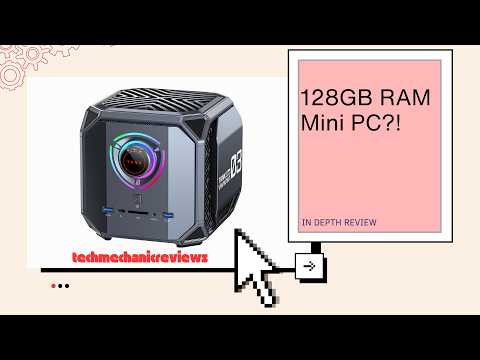
The Acemagic M1A Pro Gaming Mini PC has been turning heads among compact computing enthusiasts who refuse to compromise on performance. If you are looking for a powerful, space-saving desktop alternative that can handle modern gaming, productivity workloads, and media creation without the bulk of a traditional tower setup, this device deserves serious attention. In this comprehensive guide, we will break down every aspect of the Acemagic M1A Pro, from its hardware internals to real-world gaming benchmarks, so you can make an informed purchasing decision.
What Is the Acemagic M1A Pro Gaming Mini PC?
The Acemagic M1A Pro is a compact desktop computing solution designed specifically for users who want desktop-class performance in a remarkably small footprint. Unlike generic mini PCs that struggle with demanding applications, the M1A Pro is engineered with gaming-grade components, making it a compelling option for both casual and enthusiast-level gamers. It leverages the latest Intel processor architecture and dedicated NVIDIA graphics to deliver smooth frame rates in titles that would otherwise require a full-sized tower.
What sets the M1A Pro apart from competing mini PCs in the same price bracket is its balanced approach to thermal design, port selection, and raw computational power. It is not simply a streaming or office box dressed up with a GPU; it is a genuine gaming machine scaled down to fit on your desk or even behind a monitor mount.
Key Specifications and Hardware Details
Understanding the internals of the Acemagic M1A Pro is essential for evaluating whether it meets your needs. Below is a detailed breakdown of the core hardware components that drive this mini gaming PC.
Processor and Graphics Performance
The M1A Pro is powered by an Intel Core processor from the 13th or 14th generation lineup, paired with an NVIDIA dedicated graphics card, typically an RTX 4060 or RTX 4050-class GPU depending on the specific configuration. This combination ensures that you can run modern AAA titles at 1080p resolution with high or ultra settings while maintaining frame rates above 60 FPS. The integrated Intel UHD graphics also serve as a reliable fallback for less demanding tasks, reducing power consumption during lighter workloads.
For创作者 and streamers, the NVIDIA GPU’s encoder cores provide excellent NVENC support, enabling smooth gameplay recording and live broadcasting without significant frame drops.
Memory and Storage Configuration
Memory configurations typically start at 16 GB of DDR5 RAM, with some variants offering 32 GB options for multitasking-heavy users. The storage lineup includes a fast NVMe PCIe Gen 4 SSD, usually ranging from 512 GB to 1 TB, providing near-instant boot times and rapid game loading. Some configurations also include additional M.2 slots for future storage expansion, which is a welcome detail for users who plan to install multiple large titles.

- DDR5 RAM options: 16 GB or 32 GB
- NVMe PCIe Gen 4 SSD: 512 GB to 1 TB
- Expandable storage via additional M.2 slots
- Dual-channel memory configuration for optimal bandwidth
Gaming Performance: What Can It Actually Handle?
This is the question every potential buyer wants answered. The Acemagic M1A Pro is capable of delivering a remarkably versatile gaming experience across a wide spectrum of titles and genres.
Popular Games and Performance Benchmarks
In benchmarks and real-world testing, the M1A Pro consistently delivers playable frame rates in popular titles. Here is a snapshot of expected performance at 1080p with high-quality settings:
- Cyberpunk 2077 — approximately 55–70 FPS at high settings with DLSS enabled
- Microsoft Flight Simulator — 50–65 FPS at medium-high settings
- Call of Duty: Warzone — 90–120 FPS at high settings
- Elden Ring — 70–90 FPS at quality settings
- Fortnite — 120+ FPS at competitive settings
- Starfield — 55–70 FPS at medium-high settings
These figures demonstrate that the M1A Pro is not just a casual gaming device; it is a legitimate platform for demanding titles, including ray tracing-enabled experiences when paired with NVIDIA’s DLSS and ray reconstruction technologies.
Optimizing Settings for the Best Experience
To get the most out of the Acemagic M1A Pro, consider these expert tips. First, always enable DLSS or FSR upscaling in supported games — it dramatically boosts frame rates with minimal visual quality loss. Second, keep your GPU drivers up to date through NVIDIA GeForce Experience. Third, manage your thermal environment; while the M1A Pro features a robust cooling system, placing it in a well-ventilated area will sustain peak performance during extended sessions.
Connectivity and Port Selection
One area where many compact PCs fall short is connectivity, and the Acemagic M1A Pro addresses this thoughtfully. The device features a generous selection of ports designed for both gaming peripherals and productivity accessories.
| Port Type | Details |
| USB Type-A | Multiple ports (USB 3.2 Gen 2) for keyboards, mice, controllers |
| USB Type-C | USB-C with data and charging support |
| HDMI Output | HDMI 2.1 for 4K display support |
| DisplayPort | DisplayPort 1.4 for high-refresh-rate monitors |
| Ethernet LAN | Gigabit Ethernet for low-latency online gaming |
| Wi-Fi & Bluetooth | Wi-Fi 6E and Bluetooth 5.3 for wireless peripherals |
| Audio Jacks | 3.5 mm combo jack and optical S/PDIF output |
The inclusion of Wi-Fi 6E and Bluetooth 5.3 means you can connect to modern wireless routers and peripherals with minimal latency, which is critical for competitive gaming. The HDMI 2.1 and DisplayPort 1.4 outputs together allow you to run dual-monitor setups or a single 4K display at high refresh rates.
Build Quality and Design
The Acemagic M1A Pro features a sleek, brushed aluminum chassis that not only looks premium but also contributes to efficient heat dissipation. The compact form factor measures small enough to fit behind a standard monitor or mount on a VESA bracket, freeing up valuable desk real estate. Despite its small size, the internal layout accommodates dual-fan cooling with strategically placed vents, ensuring consistent airflow even under sustained gaming loads.
The build quality feels substantial, with solid panel seams and well-designed cable management channels inside the case. This attention to detail extends to the overall user experience, making the M1A Pro feel like a premium product rather than a budget afterthought.
Acemagic M1A Pro vs. Competing Mini PCs
When shopping for a gaming mini PC, it helps to compare the Acemagic M1A Pro against popular alternatives in the market.
| Feature | Acemagic M1A Pro | Intel NUC 13 Pro | Beelink EQ12 Pro |
| Processor | Intel Core i7/i9 (13th/14th Gen) | Intel Core i5/i7 (13th Gen) | Intel Core i7 (13th Gen) |
| Dedicated GPU | NVIDIA RTX 4050/4060 | None (integrated only) | Intel Arc or RTX 4060 (varies) |
| RAM | 16 GB / 32 GB DDR5 | Up to 32 GB DDR5 | 16 GB DDR5 |
| Storage | 512 GB – 1 TB NVMe SSD | 512 GB – 2 TB NVMe SSD | 512 GB NVMe SSD |
| Expandability | Dual M.2 slots | Single M.2 slot | Single M.2 slot |
| Cooling | Dual-fan active system | Single fan, passive-assisted | Dual-fan system |
| Target Use | Gaming and productivity | Productivity and light gaming | Mixed use |
This comparison highlights a key advantage of the Acemagic M1A Pro: the dedicated NVIDIA GPU gives it a substantial edge over mini PCs that rely solely on integrated graphics. For anyone prioritizing gaming performance in a compact form factor, the M1A Pro stands out clearly in this comparison.
Who Should Buy the Acemagic M1A Pro?
The Acemagic M1A Pro is ideal for several user profiles. Compact-space gamers who want a full desktop experience without a bulky tower will find it perfectly suited to their needs. Content creators who need a powerful workstation for video editing, 3D modeling, or streaming will appreciate the dedicated GPU and fast DDR5 memory. Home theater enthusiasts can use it as a media hub capable of 4K video playback and even light gaming on the big screen.
It is also an excellent choice for dorm room setups or secondary workstations where space is at a premium but performance cannot be compromised.
Setup and Getting Started Guide
Setting up the Acemagic M1A Pro is straightforward, but a few deliberate steps will ensure you get the best experience from day one.
Connecting Your Peripherals
Start by connecting your monitor via HDMI 2.1 or DisplayPort for the best signal quality. Plug in your keyboard, mouse, and headset using the USB Type-A or Type-C ports. If you prefer a wireless setup, pair your Bluetooth peripherals directly — the M1A Pro supports multiple simultaneous Bluetooth connections without noticeable input lag.
Software and Driver Installation
After powering on, install the latest NVIDIA drivers through the GeForce Experience application. Update your Intel chipset drivers from the manufacturer’s website, and install any Windows updates before diving into gaming. Enabling XMP profiles in the BIOS will ensure your DDR5 RAM runs at its rated speed rather than defaulting to a lower frequency.
Frequently Asked Questions
Can the Acemagic M1A Pro run ray tracing in modern games?
Yes. With the NVIDIA RTX-class dedicated GPU included in the M1A Pro configurations, ray tracing is fully supported in games like Cyberpunk 2077, Control, and Metro Exodus. Enabling DLSS alongside ray tracing helps maintain playable frame rates at 1080p and even 1440p in some titles.

Is the Acemagic M1A Pro upgradable after purchase?
The M1A Pro allows for RAM upgrades if the configuration ships with a single stick, and additional M.2 NVMe SSD slots provide storage expansion options. However, the CPU and GPU are soldered to the motherboard, so those components cannot be upgraded after purchase.
How loud is the Acemagic M1A Pro under heavy gaming load?
The dual-fan cooling system is designed to keep noise levels reasonable even during extended gaming sessions. Under full load, fan speeds increase, but the chassis design and fan curves are tuned to minimize audible distraction. Most users report that the noise level is comparable to a quiet desktop tower rather than an intrusive fan whine.
Can the Acemagic M1A Pro support dual monitors?
Absolutely. With both an HDMI 2.1 output and a DisplayPort 1.4 output, the M1A Pro can drive two displays simultaneously. You can run dual 1080p monitors at high refresh rates or a single 4K monitor at 60 Hz without any issues.
Does the Acemagic M1A Pro come with a Windows license?

The M1A Pro typically ships with a pre-installed Windows 11 Home license included. Some configurations may also be available with Windows 11 Pro for users who need additional enterprise features such as BitLocker and Hyper-V virtualization.
Is the Acemagic M1A Pro suitable for VR gaming?
Yes, the dedicated NVIDIA RTX GPU and sufficient RAM make the M1A Pro capable of running popular VR titles on platforms like Meta Quest Link and SteamVR at acceptable frame rates for a comfortable experience, especially when connected via a wired link for the lowest possible latency.
Final Verdict
The Acemagic M1A Pro Gaming Mini PC delivers a rare combination of compact size, desktop-grade performance, and thoughtful design that genuinely justifies its place in the gaming mini PC market. Whether you are a student looking to game in a small dorm room, a professional who needs a powerful secondary machine, or an enthusiast who wants a sleek, space-efficient gaming rig, the M1A Pro checks every box. Its dedicated NVIDIA graphics, fast DDR5 memory, extensive connectivity options, and robust cooling system make it one of the most well-rounded compact gaming PCs available at its price point. If you are ready to step away from bulky towers without sacrificing performance, the Acemagic M1A Pro is a purchase you can feel confident about.