


Social media apps have fundamentally transformed the way billions of people communicate, share content, discover news, build brands, and even earn a living. From short-form video platforms to professional networking tools, the landscape of social media applications has exploded into a sprawling ecosystem that touches virtually every aspect of modern digital life. Whether you are a casual user scrolling through your feed, a small business owner building a customer base, or a marketer analyzing engagement metrics, understanding the full spectrum of social media platforms is no longer optional — it is essential. In this comprehensive guide, we break down every major category of social media apps, compare the top platforms head-to-head, and provide practical insights to help you navigate the ever-evolving world of social networking.
What Exactly Qualifies as a Social Media App?
A social media app is any software application that enables users to create profiles, share user-generated content, interact with other users, and build networks or communities online. These platforms rely on algorithms, feeds, and engagement signals to surface content and keep users returning. What makes the category so vast is that social media apps span messaging, video, photo sharing, professional networking, discussion forums, live streaming, and even virtual worlds.
Understanding this breadth matters because different platforms serve entirely different purposes. A platform designed for professional career development operates on a completely different engagement model than one built for viral entertainment or private messaging.
Major Categories of Social Media Apps
The social media ecosystem can be organized into several distinct categories. Each category hosts dozens of apps, but a handful dominate global usage and cultural relevance.
1. Social Networking Platforms
These are the foundational platforms that most people associate with the term “social media.” They focus on connecting friends, family, and communities through text posts, photos, videos, and events.
- Facebook — The largest social networking site by monthly active users, still dominant among older demographics and local community groups.
- Meta (Facebook, Instagram, Threads) — Meta’s ecosystem spans multiple apps targeting different user behaviors, from visual storytelling to real-time public conversations.
- Nextdoor — A hyper-local networking app focused on neighborhood-level communication, community safety, and local business recommendations.
2. Short-Form Video Platforms
Short-form video has become the single most consumed content format globally. These apps prioritize entertainment, trends, and algorithm-driven discovery.
- TikTok — The pioneer of algorithmically curated short-form video, with a massive creative community and powerful creator monetization tools.
- Instagram Reels — Integrated directly into the Instagram ecosystem, Reels leverage Instagram’s existing user base and visual-first identity.
- YouTube Shorts — Google’s answer to the short-form video trend, benefiting from YouTube’s massive search-driven audience and long-form content library.
3. Photo and Visual Storytelling Apps
Visual content remains king in social media. Photo-centric apps attract users who prioritize aesthetics, curated feeds, and visual storytelling.
- Instagram — Originally a photo-sharing app, Instagram now supports reels, stories, direct messaging, and shopping.
- Pinterest — A visual discovery engine where users browse and save inspiration boards, heavily used for planning, design, and shopping.
- Snapchat — A multimedia messaging app centered on ephemeral photo and video messages, popular with younger demographics.
4. Professional and Career Networking Apps
These platforms serve a completely different audience — professionals seeking career advancement, recruiters, and B2B businesses.
- LinkedIn — The undisputed leader in professional networking, offering job search, thought leadership publishing, and recruitment tools.
- Xing — A European alternative to LinkedIn, particularly popular in German-speaking markets.

5. Messaging and Community Apps
Messaging apps often double as social platforms, especially in regions where they serve as the primary internet experience for billions of users.
- WhatsApp — The most widely used messaging app globally, with over two billion users, primarily in India, Brazil, and parts of Europe and Africa.
- Telegram — Known for its privacy features, large group support, and channel-based broadcasting, popular among tech-savvy communities.
- Discord — Originally a gaming communication tool, Discord has evolved into a general-purpose community platform with servers, channels, and voice chat.
- WeChat — China’s all-in-one super app combining messaging, payments, social media, and mini-programs into a single ecosystem.
6. Microblogging and Public Conversation Platforms
These platforms emphasize real-time text-based conversations, news dissemination, and public discourse.
- X (formerly Twitter) — A real-time microblogging platform central to news, politics, sports, and public conversations worldwide.
- Reddit — A forum-based platform organized into thousands of subreddits, where communities discuss niche topics from deep expertise.
Comparison of Top Social Media Apps
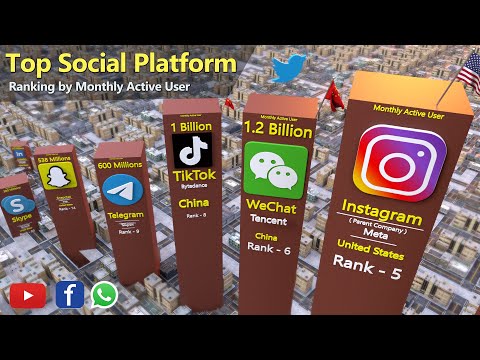
Not all social media platforms are created equal. The table below compares leading apps across key metrics that matter to users, marketers, and businesses.
| Platform | Primary Format | Monthly Active Users (approx.) | Top Demographic | Best For |
| Text, photo, video, groups | 3.07 billion | 25–65+ | Community groups, local business, event promotion | |
| Photo, video, reels, stories | 2.0 billion | 18–44 | Visual branding, influencer marketing, e-commerce | |
| TikTok | Short-form video | 1.58 billion | 16–35 | Viral content, brand awareness, creator economy |
| Text, articles, professional networking | 950 million | 25–55 | B2B marketing, recruiting, thought leadership | |
| X (Twitter) | Text microblogging | 550 million | 25–49 | News, real-time conversation, public discourse |
| Snapchat | Ephemeral messaging, stories | 800 million | 13–34 | Youth engagement, AR experiences, behind-the-scenes content |
| Messaging, status updates | 2.0+ billion | All ages | Direct communication, business messaging, community updates | |
| YouTube | Long-form and short-form video | 2.5+ billion | 18–54 | Educational content, long-form video, search-driven discovery |
How to Choose the Right Social Media Platform
Choosing the right social media apps depends on your goals, target audience, and the type of content you plan to create. Here is a practical framework to guide your decision:
- Define your objective. Are you building brand awareness, driving website traffic, generating leads, or building a personal brand? Each objective maps to different platforms.
- Know your audience demographics. Instagram and TikTok skew younger, while Facebook and LinkedIn attract older, more professional audiences. Research where your ideal audience spends time.
- Consider content format. If you are a visual creator, Instagram and TikTok are natural fits. If you produce long-form educational content, YouTube and LinkedIn perform best.
- Evaluate engagement style. Some platforms favor one-to-one interaction (WhatsApp, DM), while others thrive on public broadcasting (X, TikTok, YouTube).
- Start with two to three platforms. Spreading yourself too thin across every social media app leads to burnout. Master a few platforms before expanding.
Expert Tip: Cross-Platform Repurposing
One of the most effective strategies for managing multiple platforms is content repurposing. A single long-form YouTube video can be clipped into five or more TikTok and Instagram Reels. A LinkedIn article can be adapted into a Twitter thread. This approach saves time while maintaining a consistent presence across your chosen social media apps.
The Evolving Landscape of Social Media Apps
The social media industry is undergoing rapid transformation. Several trends are reshaping how people interact with social media platforms in 2024 and beyond:
- The rise of AI-generated content. Platforms like TikTok and Meta are integrating AI tools that allow users to create content with minimal effort, raising questions about authenticity and creative ownership.
- Threads and decentralized alternatives. Meta’s Threads app launched as a direct competitor to X, focusing on conversational, text-based public discussion. Meanwhile, platforms like Mastodon and Bluesky are gaining traction among users seeking alternatives to algorithmically dominated feeds.
- Social commerce integration. Instagram, TikTok, and Pinterest have all heavily invested in in-app shopping features, turning social media apps into full-fledged marketplaces.
- Privatization and ephemeral content. Users are increasingly migrating toward private messaging groups and ephemeral content formats, driven by privacy concerns and a desire for more authentic, less performative interactions.
- Audio and live-streaming resurgence. Live audio rooms on platforms like X, LinkedIn, and Discord are creating new formats for real-time community engagement.
Staying informed about these trends is critical for anyone who wants to maintain relevance in the digital space. The platforms that dominate today may not be the same ones that dominate in five years, so flexibility and continuous learning are key.
Common Mistakes People Make on Social Media Apps
Even experienced users and marketers fall into predictable traps. Here are the most common mistakes to avoid:
- Ignoring analytics. Every major social media platform offers built-in analytics tools. Neglecting them means you are guessing instead of learning what content resonates.
- Posting without a strategy. Consistency without direction leads to wasted effort. Define your content pillars, posting schedule, and engagement goals before you start.
- Chasing every trend. Not every viral format is relevant to your brand or audience. Participate in trends only when they align with your values and message.
- Neglecting community management. Social media is a two-way conversation. Failing to respond to comments and messages damages trust and reduces reach.
- Overlooking platform-specific features. Each social media app rewards native content. Uploading a YouTube link on TikTok, for example, will get less reach than creating content natively within the platform.
Conclusion
The world of social media apps is vast, diverse, and constantly evolving. From the short-form video dominance of TikTok to the professional depth of LinkedIn, each platform serves a unique purpose and attracts a distinct audience. The key to success lies not in being everywhere at once, but in understanding where your audience lives, what format they prefer, and how to deliver genuine value within those digital spaces. By staying informed, adapting to new trends, and maintaining a strategic approach, you can harness the full power of social media to connect, grow, and thrive.
Frequently Asked Questions
The top five social media applications by monthly active users are Facebook, YouTube, WhatsApp, Instagram, and TikTok. Together, these five platforms account for the vast majority of global social media engagement and represent the most significant opportunities for both personal and business use.
Instagram and Facebook remain the best choices for most small businesses due to their built-in shopping features, local business tools, and massive user bases. TikTok is also increasingly valuable for small businesses looking to reach younger demographics through authentic, creative short-form video content.
Yes. Threads, Bluesky, Lemon8, and BeReal represent emerging platforms that are gaining traction. Threads positions itself as a conversational alternative to X, Bluesky offers a decentralized microblogging experience, Lemon8 targets the lifestyle and beauty niche, and BeReal emphasizes authentic, unfiltered daily sharing.
LinkedIn is overwhelmingly the best social media app for professional networking. It offers job listings, industry groups, content publishing, recruiter messaging, and a professional identity that no other platform matches. For regional alternatives, Xing serves European markets well.
There are thousands of social media apps worldwide. While a handful dominate global usage, the long tail includes hundreds of regional, niche, and community-specific platforms. The total count changes frequently as new apps launch and others decline in popularity or shut down.