The history of social media is a fascinating journey that spans several decades of technological innovation, cultural shifts, and the ever-changing way human beings connect with one another. What started as simple text-based bulletin boards and early networking experiments in the 1970s has evolved into a global digital ecosystem that shapes nearly every aspect of modern life. Understanding the evolution of social media platforms gives us valuable insight into how communication, marketing, politics, and even mental health have been transformed over the years. In this comprehensive guide, we will walk through the key milestones, explore the platforms that defined each era, and examine what the future of social networking might look like.
The Early Roots of Social Media
Before platforms like Instagram and TikTok dominated our screens, the foundations of social networking were being laid in academic and research environments. The earliest forms of online communication emerged in the 1960s and 1970s, long before the average person had access to a personal computer. These pioneering systems laid the groundwork for everything we know today about digital interaction and community building.
ARPANET and Early Online Communication
The Advanced Research Projects Agency Network (ARPANET), created by the U.S. Department of Defense in the late 1960s, is widely considered the precursor to the modern internet. It allowed researchers at different universities to share messages and data. While it was not social media in the traditional sense, it introduced the concept of electronic communication between multiple users — the very essence of social networking.
Bulletin Board Systems (BBS) in the Late 1970s and 1980s
Bulletin Board Systems, or BBS, were among the first platforms where people could create accounts, post messages, and interact with others online. These text-based systems operated on single computers connected via telephone lines. Users would dial in to access forums, download files, and participate in discussions. Key highlights of BBS culture include:
- Localized communities centered around shared interests like gaming, programming, and music
- The rise of early online identities and usernames
- Foundational skills in digital etiquette and community moderation
- Predecessors to modern forums like Reddit and Discord
CompuServe and AOL: Bringing the Internet to the Masses

In the 1980s and early 1990s, services like CompuServe and America Online (AOL) made the internet accessible to everyday consumers. AOL became synonymous with the early internet experience, offering chat rooms, instant messaging, and early social features. These platforms helped millions of people understand what it meant to communicate online, effectively preparing the public for the social media boom that was coming.
The Rise of Modern Social Media Platforms
Blogging and Early Networking Sites (Late 1990s – Early 2000s)
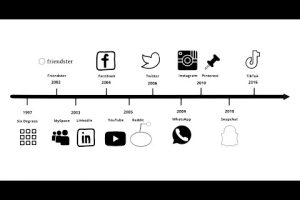
The late 1990s saw the emergence of platforms that began to resemble the social media we recognize today. Six Degrees, launched in 1997, is often cited as the first true social media site. It allowed users to create profiles, list friends, and browse other users’ networks. Although it shut down in 2001, the concept of a social networking profile became the blueprint for future platforms.
Other significant platforms from this era include:
- LiveJournal (1999) — A blogging platform that emphasized community and personal expression
- Friendster (2002) — A pioneering social network that popularized the friend-connection model
- MySpace (2003) — The first mainstream social network that allowed extensive profile customization and became a launching pad for musicians
- LinkedIn (2003) — Focused on professional networking and career development
The Facebook Revolution and Platform Wars
No discussion of the history of social media is complete without acknowledging Facebook’s impact. Launched in 2004 by Mark Zuckerberg and his Harvard classmates, Facebook started as a campus-only network before expanding to universities, high schools, and eventually the general public. Its clean interface, real-name policy, and powerful algorithm for connecting people helped it overtake competitors rapidly.
The mid-to-late 2000s also saw the rise of microblogging and photo-sharing platforms. Twitter launched in 2006 with its signature 140-character limit, creating a new format for real-time public conversation. YouTube, founded in 2005, revolutionized video sharing and user-generated content. Meanwhile, Instagram arrived in 2010, proving that visual storytelling had enormous appeal.
Social Media Through the Decades: A Timeline
The chronological evolution of social media tells a compelling story about how technology and culture have co-evolved. Here is a concise timeline of the most important milestones.
| Year | Milestone | Significance |
| 1978 | First BBS created | Introduced online community forums |
| 1997 | Six Degrees launches | First recognizable social networking site |
| 2002 | Friendster launches | Pops the social networking bubble in the U.S. |
| 2003 | MySpace and LinkedIn launch | MySpace becomes the largest social network by 2006 |
| 2004 | Facebook launches | Reshapes how the world connects online |
| 2005 | YouTube launches | Democratizes video content creation |
| 2006 | Twitter launches | Creates the real-time public conversation model |
| 2010 | Instagram launches | Popularizes visual-first social sharing |
| 2011 | Snapchat launches | Introduces ephemeral, disappearing content |
| 2016 | TikTok (Musical.ly) launches globally | Short-form video becomes the dominant content format |
How Social Media Has Transformed Communication
The impact of social networking on human communication cannot be overstated. Platforms have fundamentally changed how we share information, form opinions, maintain relationships, and even perceive the world around us. Several key transformations stand out.
Real-time global communication became possible with platforms like Twitter and Facebook, allowing events to be discussed instantly across continents. User-generated content shifted the power from traditional media outlets to ordinary individuals, enabling anyone with a smartphone to become a publisher. Influencer culture emerged as a legitimate career path, with individuals building audiences and monetizing their online presence.
Businesses also underwent a dramatic transformation. Social media marketing evolved from a novelty into a multi-billion-dollar industry. Brands now rely on platforms like Instagram, TikTok, and YouTube to reach consumers directly, often bypassing traditional advertising channels entirely. The rise of social commerce — where users can purchase products directly through social platforms — represents the latest evolution in this space.
The Future of Social Media
Looking ahead, several trends are shaping where social media is heading. Artificial intelligence is playing an increasingly central role in content curation, recommendation algorithms, and even content creation through AI-generated posts and images. Decentralized social networks are gaining traction as users seek more control over their data and online identities. Virtual and augmented reality technologies promise to create immersive social experiences that go beyond the flat screen.
Privacy concerns and regulatory scrutiny are also reshaping the landscape. Governments around the world are introducing data protection laws that will force platforms to rethink how they collect, store, and use personal information. The next generation of social media platforms will likely prioritize user control, transparency, and ethical design from the ground up.
Expert tip: if you are studying the history of social media for research or professional purposes, focus on understanding the relationship between platform design choices and user behavior. The most successful platforms are those that align with natural human communication patterns — brevity on Twitter, visual storytelling on Instagram, and authentic connection on Snapchat.

Frequently Asked Questions

The origins of social media trace back to 1997 with the launch of Six Degrees, which is widely recognized as the first social networking site. However, the conceptual roots go back even further to BBS systems and ARPANET in the 1970s and 1980s, where early digital communities began forming.
MySpace is often considered the first major mainstream social media platform. It became the most visited social networking site in the world by 2006, surpassing Google in global web traffic for a period. Its customizable profiles and music integration made it a cultural phenomenon, especially among teenagers and young adults.
Over the last two decades, social media has evolved from text-heavy profile-based networks to visually driven, algorithmically curated platforms. The shift from desktop to mobile access, the rise of short-form video content, and the integration of e-commerce features have all dramatically changed how people interact with social platforms daily.
Social media has been instrumental in organizing political movements worldwide, from the Arab Spring in 2011 to the Black Lives Matter movement and various democratic elections. Platforms like Twitter and Facebook enabled rapid information sharing, grassroots organization, and global awareness of social justice causes in ways that were previously impossible.
As of recent data, Facebook remains the largest social media platform by monthly active users, with billions of users globally. However, platforms like YouTube, WhatsApp, and TikTok have also amassed enormous user bases, with TikTok experiencing the fastest growth in recent years, particularly among younger demographics.
Conclusion
The history of social media is a story of relentless innovation and profound cultural change. From humble beginnings in university research labs and dial-up BBS forums to the sophisticated, algorithm-driven platforms we use every day, social networking has reshaped the fabric of human connection. Each era introduced new possibilities and new challenges, from privacy concerns to misinformation to the democratization of voice and creativity. As we look to the future, one thing is certain: social media will continue to evolve, and understanding its history is essential for navigating the digital world we all share today. Whether you are a casual user, a business owner, or a researcher studying digital communication, the journey of social media offers endless lessons about technology, society, and the enduring human need to connect.